 |
GL CHOCO ENGINE
|
|
GL CHOCO ENGINE
|
Platform System is a subsystem that provides a swappable, platform-agnostic interface API so that application developers can build graphics applications without being aware of the underlying platform.
To achieve this goal, Platform System applies the object-oriented design pattern Strategy. The Strategy pattern typically has the following structure:
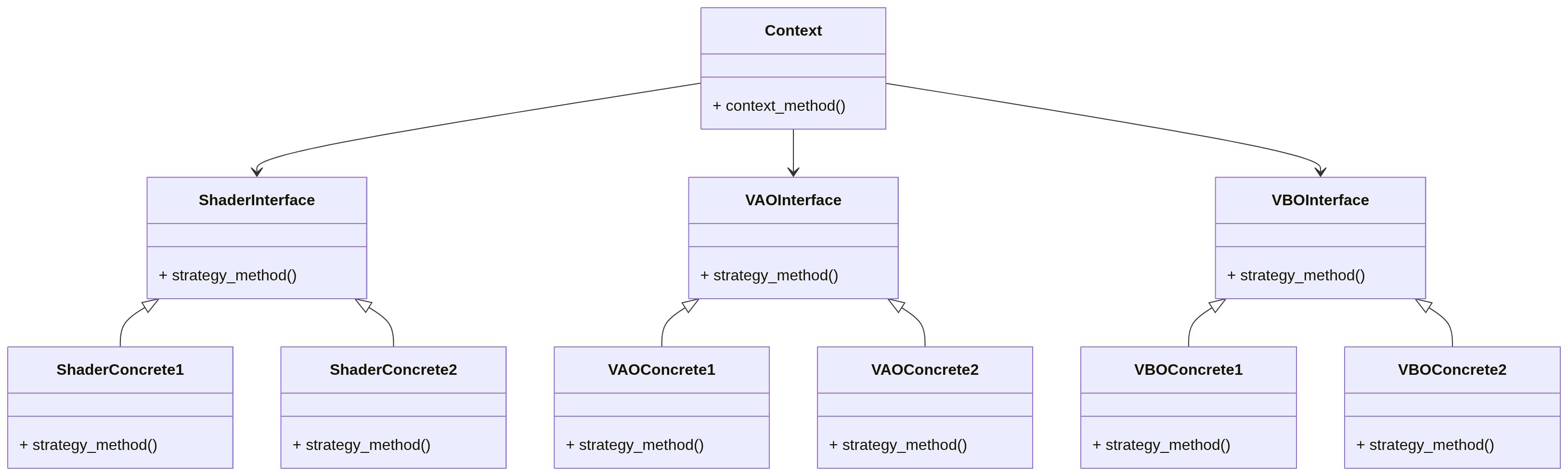
The correspondence between the Strategy objects and GLCE modules is as follows.
| Strategy Object | GLCE Module | Role |
|---|---|---|
| Context | platform_context | Provides API entry points for the functionality owned by Platform System to upper layers |
| Interface | platform_interface | Provides a per-platform swappable virtual function table (vtable) to the Context (holding abstracted platform APIs) |
| Concrete1 | platform_glfw | Provides the GLFW-based vtable implementation for the Interface and its internal implementation |
| Concrete2 | Not implemented | Added when supported platforms increase |
In addition, Platform System provides the following modules that support the Strategy-based design.
| Module | Role |
|---|---|
| platform_err_utils | For all Platform System modules, provides (1) conversion from lower-layer result codes to Platform System result codes, and (2) conversion of Platform System result codes to strings |
| platform_types | Provides common data types shared across all Platform System modules |
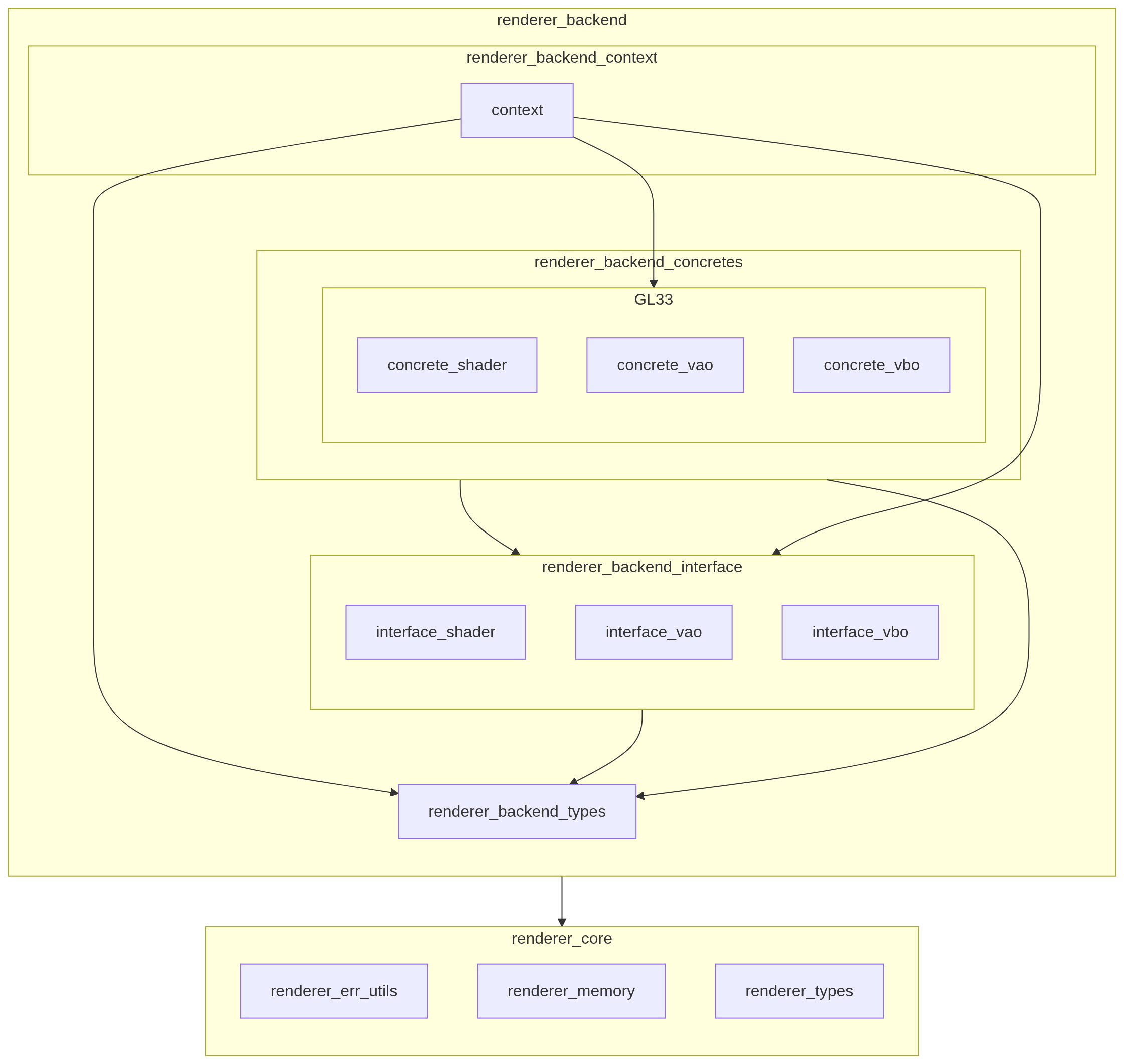
Currently, the platform to use is selected by specifying it when creating an instance of Platform System.
With the current specification, all platform concrete implementations must be buildable, which is difficult to achieve. In the future, the system will migrate to a build-option-based approach where the platform is selected via build options.
Platform Context exposes platform_context_t to upper layers as the structure that manages the internal state of the system (only the type name is exposed; the internal structure is not public). An instance of platform_context_t is held by the application-layer internal state structure app_state_t under the instance name platform_context. The application layer is also responsible for allocating and releasing the resources of the platform_context instance.
Platform System is brought up at system startup and stays resident until system shutdown. Therefore, since it does not release resources during execution, the memory resources for Platform System use the Linear Allocator. The Linear Allocator held by app_state_t as linear_alloc serves as the subsystem allocator, and Platform System uses it.
The usage flow is as follows.
| Phase | Operation | Method |
|---|---|---|
| Initialization | Allocate resources for platform_context | Call platform_initialize() in application_create() |
| Initialization | Create the rendering window | Call platform_window_create() in application_create() (planned to be moved after renderer_frontend is created) |
| Shutdown | Release resources for platform_context | Call platform_destroy() in application_destroy() |
| Runtime (per-frame) | Pump events from the Platform layer | Call platform_pump_messages() in application_run() (per-frame) |
| Runtime (per-frame) | Swap buffers via double buffering | Call platform_swap_buffers() in application_run() (per-frame) (planned to be moved after renderer_frontend is created) |
For event pumping via platform_pump_messages(), refer to the Event System Guide.
The following items are not supported at this time. They may be supported as GLCE evolves, as needed.
No configuration options are available at this time.
When adding a supported platform, refer to the Platform System Guide.
 1.9.6
1.9.6